There are moments in a journey when travel stops being about places and becomes about encounters. Not the planned ones, not the ones you look for, but the unexpected ones that appear without warning and, precisely for that reason, stay with you far longer than any monument or landscape ever could.

In Lisbon, I often found myself stopping to watch street artists. Some of them immediately catch my attention, others less so, but every time I’m left with the same feeling: that within each of us there is some form of talent, sometimes small, sometimes hidden, that eventually finds a way to reveal itself. And maybe that is exactly the point—to notice something that usually goes unseen.

That day I was near Praça do Comércio, one of the most iconic places in the city, with the Arco da Rua Augusta standing proudly over the open square facing the river. It was early morning, and I was waiting for the tourist information office to open so I could get my Lisboa Card. Time was moving slowly, as it often does in Lisbon before 9:30, when the city is still stretching into the day. So I started walking without any real direction, simply letting myself drift through the empty space and the soft morning light filling the square.

That’s when I noticed a figure near the water. Not someone who immediately demanded attention, not someone visually striking at first glance. And yet, the longer I looked, the more I felt there was something different about the way he occupied that space.

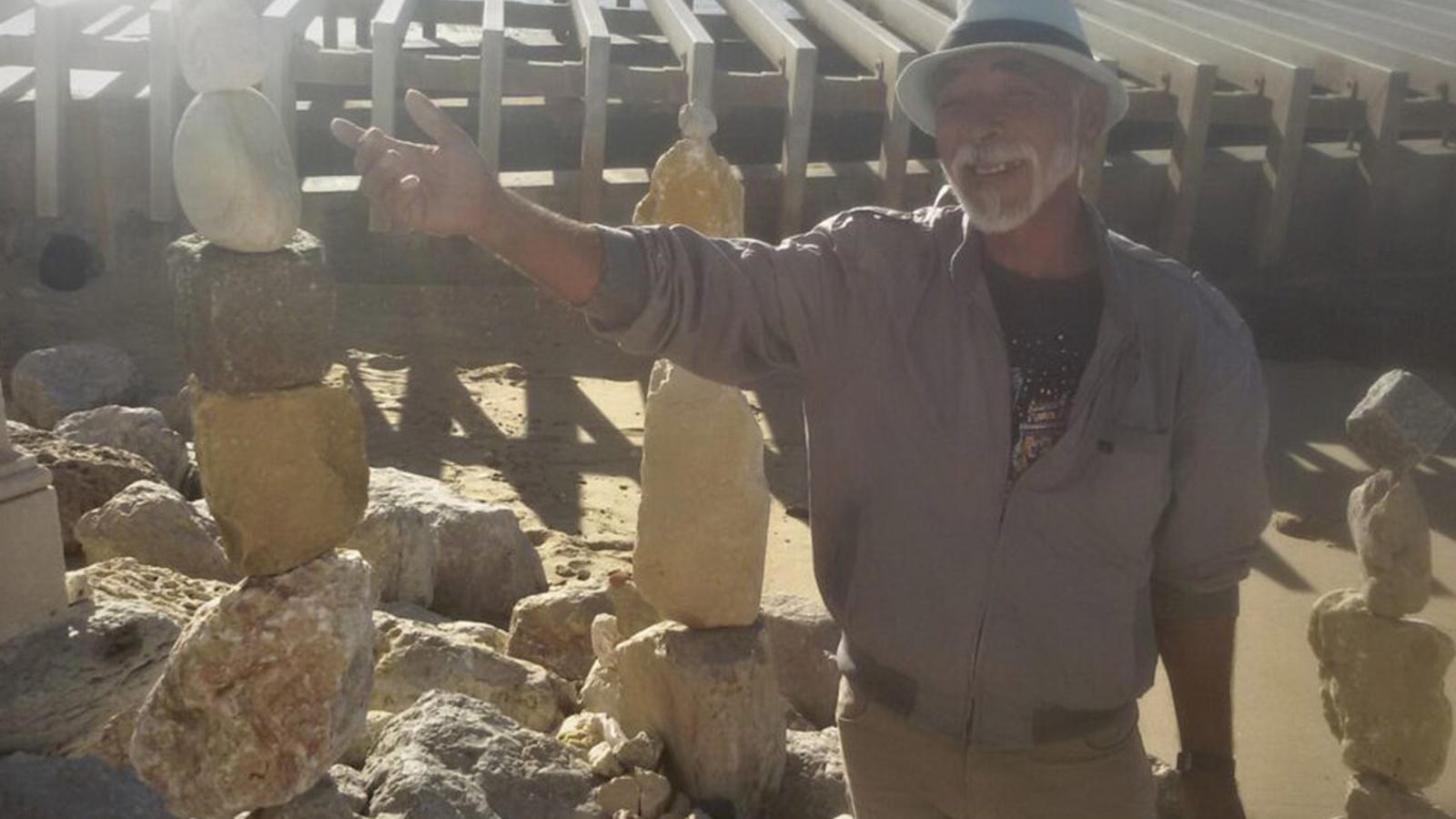
He was a man in his fifties, with a white beard and a simple hat that reminded me of a fisherman or a character from an old story. His clothes were modest, practical, nothing that would make him stand out in a crowd. And yet, what he was doing was anything but ordinary.

In front of him were stones. And with an almost unreal calmness, he began to stack them one on top of the other, searching for a balance that seemed impossible. He would observe each stone for a long time, touch it lightly, shift it by millimeters, then pause again as if waiting for the stone itself to decide where it belonged. Every movement was slow, precise, deliberate. And slowly, in front of my eyes, small vertical structures began to emerge—defying logic, defying expectation.

I had never seen anything like it in real life. Only later would I learn that this practice is called rock balancing, but at that moment the name didn’t matter at all. What mattered was the sensation of witnessing something deeply human and yet almost unreal, as if gravity itself had temporarily agreed to step aside.

I stood there without really noticing how much time had passed, taking a few photos—not just to capture an image, but to understand whether what I was seeing was truly possible. The more I watched, the more I realized there was no trick, no illusion, only absolute focus and a kind of patience that seemed outside of time.

At some point, I tried to approach him. I would have liked to ask questions, to understand who he was, where that almost meditative precision came from. But language made everything simpler and, in a way, even more authentic. He spoke Portuguese, I spoke English and Italian. A few fragmented words, not enough for a real conversation. And yet, it didn’t feel necessary.

Because communication had already happened before words—through gestures, through silence, through presence. In his slow and steady movements. In my quiet observation. In a brief smile that carried more meaning than any sentence could.

I stayed there for several minutes, almost hypnotized by his ability to turn something as simple as stones into fragile, temporary architecture. Each new structure seemed more impossible than the previous one, yet every single one stood—at least for a moment—as if it had always been meant to exist.

While I watched him work, I remembered something an Italian actor once told me: “Remember that real artists are everywhere, among us. But many of them still don’t know they are.” In that moment, the sentence stopped being just words and became something tangible, right there in a random square in Lisbon, by the river, among distracted passersby and a city slowly waking up.

I never learned his name. I don’t know where he came from, or whether anyone would even define him as an artist in the traditional sense. But I do know that, for a few minutes, he made time feel different. And maybe that alone is enough to call it art.