
Introduction
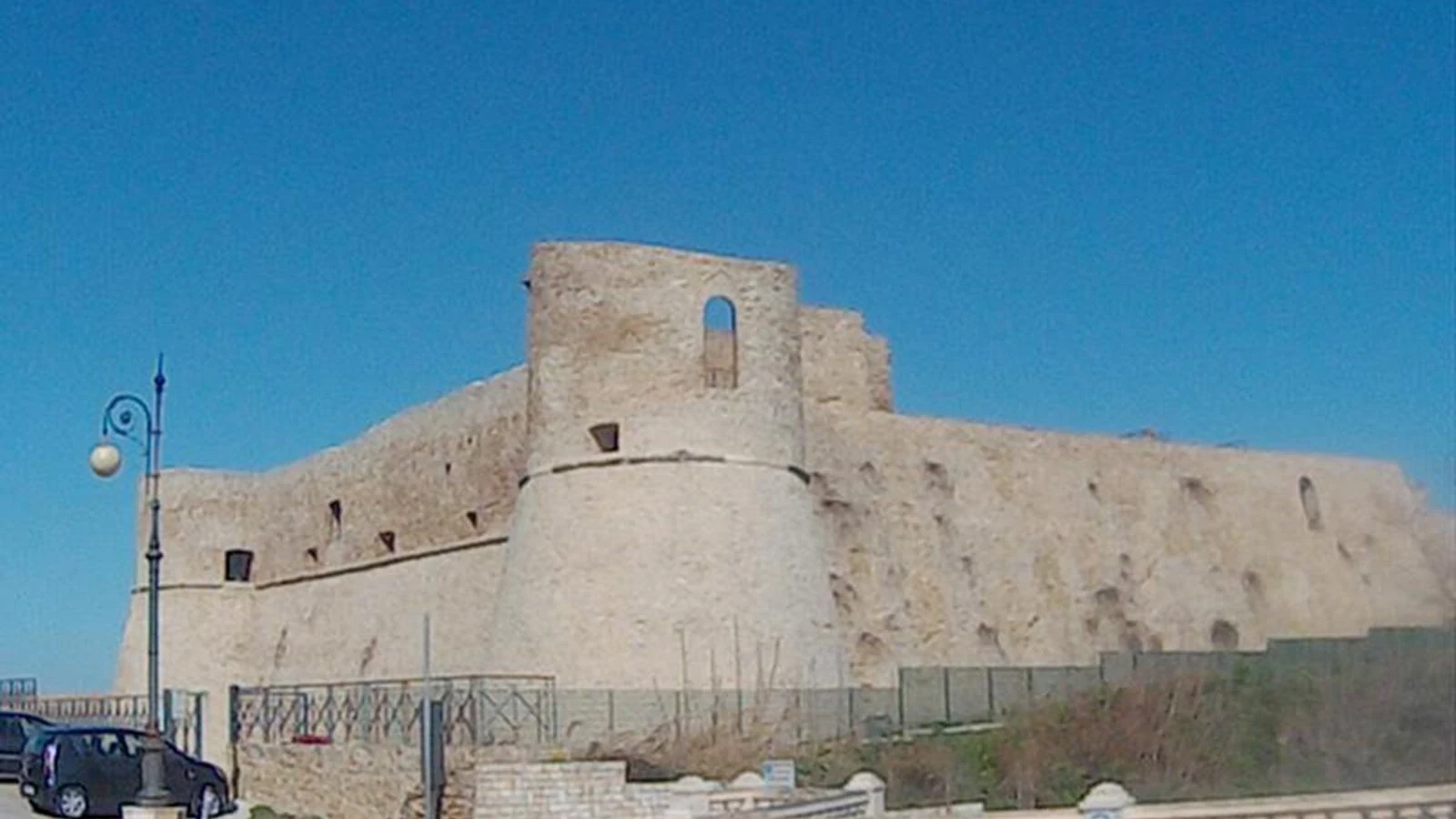
The Aragonese Castle of Ortona is one of the most important historical landmarks in Abruzzo and stands on a cliff overlooking one of the most scenic stretches of the Adriatic coast. Positioned dramatically above the sea, it represents a remarkable example of medieval military architecture that has evolved over time through destruction, reconstruction, and changes in ownership.
Its location is far from accidental. The castle was originally built for defensive purposes, designed to control the coastline and protect one of the most strategic points along the Abruzzo shoreline. Even today, when observed from below or from the terraces of the historic center, it is clear how deliberately it was positioned to dominate the landscape and ensure full visual control over the sea.
Over the centuries, the Aragonese Castle has not only served a military role but has also been a reference point for the political, economic, and cultural life of Ortona. Its walls have witnessed different historical eras, marked by significant events, sieges, architectural transformations, and changes in ownership that progressively altered its original structure.
Today, the castle is one of Ortona’s main tourist attractions and an essential stop for anyone visiting the city and the Costa dei Trabocchi. It is not only a place to admire for its architectural value, but also a key viewpoint from which to understand the history of the territory, its roots, and its unique relationship with the sea.
Although partially preserved, its structure continues to tell a complex and fascinating story, making the Aragonese Castle a true bridge between the city’s historical memory and the contemporary landscape that surrounds it.
History of the Aragonese Castle of Ortona
The history of the Aragonese Castle of Ortona is deeply connected to the military and political events that shaped the Abruzzo Adriatic coast over the centuries. Its origins date back to the Middle Ages, a period in which controlling territory and maritime routes was essential for the security and economic development of coastal cities.
A decisive turning point came in 1447, when the Venetian forces destroyed the port of Ortona and the surrounding maritime village. This event marked a rupture in the city’s history, creating the need to strengthen its defensive system. It was in this context that the reconstruction and enhancement of existing fortifications began, leading to the formation of what would become the Aragonese Castle.
The new fortress was built on pre-existing defensive structures by royal decree, funded by the entire province of Abruzzo Citra. The goal was to create a solid and strategic structure capable of controlling the sea and protecting the city from further maritime attacks.
Over the following centuries, the castle was never static. It passed through several ownership changes that influenced both its function and appearance. In 1795, it was granted in perpetual lease to the Moro family, marking the beginning of a private management phase that lasted several decades.
Later, during the 19th century, it passed to the Massari and Teti families, and eventually to Dr. Gustavo de Luca. During this period, the castle was partially adapted for residential use, with new buildings added on its eastern side. It also became a cultural meeting point, hosting notable figures such as the painter Francesco Paolo Michetti and the poet Gabriele D’Annunzio, transforming it from a purely defensive structure into a place connected to intellectual life.
The fate of the castle changed dramatically during World War II. Between 1943 and 1944, it suffered severe damage due to heavy bombing during the Battle of Ortona, one of the most intense conflicts on the Adriatic front. In 1946, further structural collapse caused the eastern section of the fortress to fall toward the sea, permanently altering its original appearance.
Despite the destruction, the castle was never completely abandoned. After the war, it came under the ownership of the Municipality of Ortona, which began preservation and restoration efforts. Today, what remains of the original structure stands as a tangible testimony of its long and complex historical evolution.
The Aragonese Castle of Ortona is therefore not just a medieval ruin overlooking the sea, but an open-air historical archive where every section reflects a different phase in the city’s past.
Architecture of the Aragonese Castle of Ortona
The architecture of the Aragonese Castle of Ortona clearly reflects its military origins and historical evolution. The fortress was originally designed as a strategic defensive structure to control the Adriatic coastline and protect the city from sea-based attacks.
The original layout had a pentagonal shape, typical of medieval military architecture designed to improve defensive capabilities and maximize visibility over the surrounding territory. This geometric configuration allowed for better coverage of firing angles and reduced blind spots, making the structure highly effective from a strategic point of view.
Over the centuries, the castle underwent numerous transformations that partially altered its original appearance. Today, approximately two-thirds of the initial structure remains, while other sections were lost due to collapses, wartime destruction, and landslides affecting the hill on which it stands.
One of its most distinctive features is its dramatic position on a cliff above the sea. The castle appears almost suspended between rock and water, a placement that originally served defensive purposes and now contributes to its status as one of the most scenic viewpoints in Ortona.
The walls, built with local stone, still retain a massive and imposing appearance typical of medieval fortifications. Despite later modifications, the original defensive logic can still be read through the thickness of the walls, the spatial organization, and the overall strategic design.
In the 19th century, when the castle became privately owned, residential additions were introduced, particularly on the eastern side. These structures, now mostly destroyed during World War II, temporarily transformed the fortress into a hybrid building, combining defensive and residential functions.
Today, the architecture of the Aragonese Castle of Ortona is the result of a complex layering of historical phases. Medieval foundations, 19th-century modifications, and wartime damage coexist within the same structure, making it not only visually striking but also historically significant.
How to Visit the Aragonese Castle of Ortona
Visiting the Aragonese Castle of Ortona means experiencing one of the city’s most iconic landmarks, where history, architecture, and landscape come together in a single place. The fortress is located in the historic center, in an elevated position overlooking the Adriatic Sea.
Reaching the castle is relatively easy, especially from the center of Ortona. The route is entirely walkable through the old town streets, characterized by gradual uphill paths, panoramic viewpoints, and a strong historical atmosphere. The journey itself becomes part of the experience, gradually leading visitors toward the upper part of the city where the castle stands.
Once at the site, the first impression is dominated by its landscape value. The elevated position offers a wide view of the Adriatic coastline, including the port, surrounding cliffs, and stretches of the Costa dei Trabocchi. This makes the visit particularly memorable, especially during hours when natural light enhances the colors of both sea and stone.
Today, the castle is accessible as a historical site and panoramic viewpoint, often included in walking itineraries through Ortona’s old town. It is not a traditional museum visit but rather an open-air experience that allows visitors to walk around the remains and understand its strategic position within the territory.
One of the most meaningful aspects of the visit is reading the landscape itself. From the castle, it is easy to understand why this location was chosen for defensive purposes: full visibility over the sea and complete control of the coastline made it strategically essential.
The best time to visit is late afternoon, when softer light enhances both the structure and the surrounding scenery. Sunset is particularly impressive, as the coastline takes on warm golden tones and the Adriatic Sea becomes even more visually striking.
The visit can also be combined with other nearby attractions in Ortona’s historic center, such as the Cathedral of San Tommaso Apostolo and several panoramic terraces overlooking the sea.
In conclusion, visiting the Aragonese Castle of Ortona is not just about observing a historical structure, but about experiencing a place where memory, identity, and landscape converge.
What to See Near the Aragonese Castle of Ortona
Exploring the area around the Aragonese Castle of Ortona means entering one of the richest parts of the city’s historic center. In just a few steps, visitors can discover churches, panoramic squares, sea viewpoints, and important cultural landmarks.
The surrounding streets are narrow and often steep, and each turn opens unexpectedly onto views of the Adriatic Sea. This constant alternation between architecture and landscape is one of the defining features of the area.
One of the main nearby landmarks is the Cathedral of San Tommaso Apostolo, located within walking distance. It is one of the most important religious buildings in Ortona, both for its architectural value and spiritual significance. The cathedral houses the relics of Saint Thomas the Apostle and represents a key religious site in Abruzzo.
Continuing through the old town, visitors encounter small squares and alleys that preserve the medieval atmosphere of Ortona. These spaces encourage slow exploration and spontaneous discovery rather than structured itineraries.
Another important feature of the area is the presence of natural viewpoints overlooking the Adriatic Sea. From these spots, the coastline unfolds from the port to the cliffs of the Costa dei Trabocchi, offering some of the most scenic views in the region.
Lower parts of the city also preserve historical traces linked to World War II, which deeply affected Ortona. These elements add a further layer of meaning to the visit, connecting cultural exploration with historical memory.
The seafront is also easily reachable and offers a completely different atmosphere, with beaches, a small port, and open views of the Adriatic horizon.
For those with more time, the castle area is an ideal starting point to explore the Costa dei Trabocchi, a unique coastal landscape featuring traditional wooden fishing structures built over the sea.
In summary, the surroundings of the Aragonese Castle are not just an extension of the visit but an essential part of the experience, helping to fully understand Ortona’s identity.
Experiences in Ortona Between History and the Sea
Ortona is a city that can only be fully understood through experience rather than simple observation. It is a place where history and landscape constantly overlap, where the historic center meets the sea, and where every street reflects this dual identity.
The historic center preserves a strong sense of identity, with narrow alleys, stone stairways, arches, and unexpected sea views. Walking through it reveals centuries of history shaped by medieval rule and the dramatic events of World War II.
The sea is a constant presence, even when not directly visible. It defines the city’s light, atmosphere, and rhythm. The port represents the most active part of Ortona, while the seafront opens the city fully toward the Adriatic.
Among the local traditions, the Nevole of Ortona stand out as a symbolic dessert of the area. These thin, crispy wafers are made using simple ingredients and cooked on patterned irons that imprint decorative designs. They are closely tied to local celebrations and family traditions, representing a more intimate side of the city’s culture.
Experiencing Ortona means moving between different dimensions: historical silence, coastal openness, and living traditions. This balance is what makes the city unique.
Conclusion
The Aragonese Castle of Ortona is not only a historical monument but one of the most representative symbols of the city’s identity. Its cliffside position makes it instantly recognizable and deeply connected to the surrounding landscape.
Over the centuries, the castle has been destroyed, rebuilt, and transformed, but its meaning has remained unchanged. From a defensive structure to a symbol of collective memory, it continues to represent Ortona’s historical evolution and its constant relationship with the Adriatic Sea.
Visiting the castle also means observing one of the most beautiful views along the Abruzzo coast, where the sea meets the city and the landscape of the Costa dei Trabocchi unfolds in the distance.
Today, the Aragonese Castle is not just a place to visit, but a point of understanding for the entire city of Ortona.


No comments yet. Be the first to comment.